Friday, October 12, 2018

Young Historians Crack the Case

Who doesn't love a good mystery? The story about what happened to the colonists of Roanoke during the late 1500s is one of our country's oldest and greatest mysteries, and it wasn't lost on these inquisitive fifth graders. 

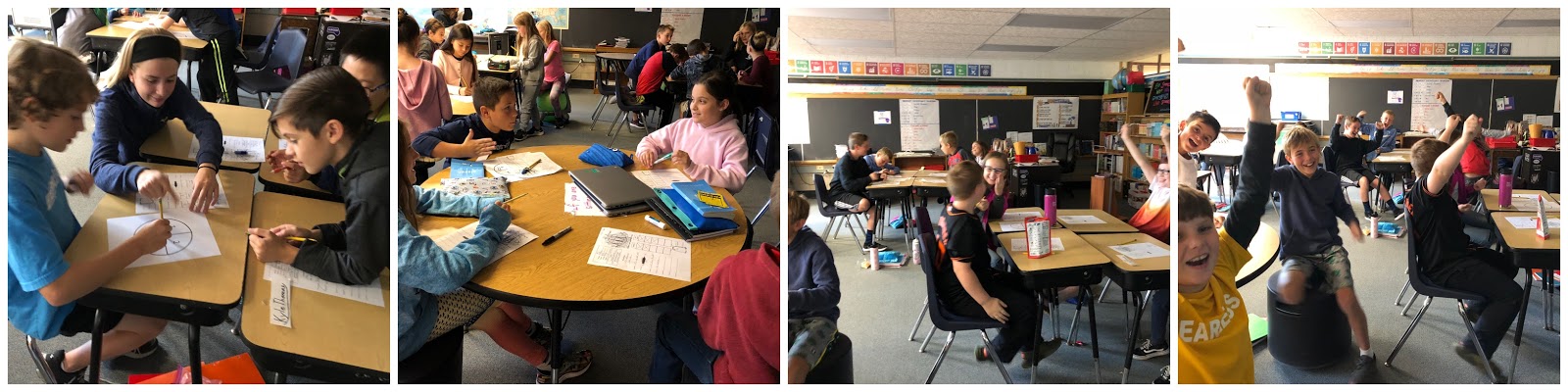
To date, historians have only been able to come up with likely hypotheses about what happened in Roanoke during the years of 1587-1590, but the question still remains: What caused the colonists of Roanoke to disappear?  Students took on the role of detectives who were assigned to research evidence and evaluate primary sources as well as existing theories about the disappearance of the Roanoke colonists. Based on each group's analysis, students then developed their own viable theories based on sufficient evidence. These theories were evaluated by small student focus groups to receive the Editor-in-Chief's approval for a once-in-a-lifetime chance to appear in the "spotlight". These young historians were given the opportunity to publish "award-winning", headline stories, proclaiming their theories to the world. 

Just another day in the life of a fifth-grade journalist. #ReadAllAboutIt


Thursday, October 4, 2018

Shared Reading: An Interactive Reading Experience

I love when a book causes students to be on the edge of their seats.  The novel, Eleven, by Tom Rogers doesn't disappoint. It does just that and so much more. 

We're using this novel for our first shared reading experience. This collaborative reading approach engages students and makes them better readers by demonstrating the skills of a proficient reader, modeling fluency, interpreting visual information in texts, introducing and reinforcing print conventions and mechanics, and activating the brain and creating connections for memory.  Just as important, this approach conveys an authentic joy of reading and motivates students to READ. It affords students the ability to share the reading experience with one another and discuss aspects of the story that might be confusing, poignant, relatable, that present opportunities to infer meaning, etc., thus creating a community of critical thinkers. This approach is a win for EVERY student. 

Our recent experience with this novel involved a literacy activity enthusiastically referred to as "Table-Top Twitter".  During this activity, students are presented with questions that require students to dig deep and think critically about the text, using evidence from the text to support their thinking. Collaboration occurs when students read and respond to one another's comments and responses, expanding on their own ideas and ways of thinking. They are learning the value of varying perspectives and how they help us evolve into global-minded thinkers, broadening our view of the world.  Who knew that a few sheets of butcher paper and some markers could elicit this much engagement and so much deep thinking. #keepitsimple

Read, write, discuss, collaborate. Repeat.


Sources:

Eggleton, Jill. “Why Is Shared Reading Important?” Where Teachers Go To Grow, blog.abramslearningtrends.com/k5/why-is-shared-reading-important.

“Shared Reading  .” Classroom Rewards Reap Dividends for Teachers and Students | Education World, www.educationworld.com/a_curr/strategy/strategy008.shtml.

Friday, September 28, 2018

Crossing the Atlantic


Students have been fully immersed in one of our first units of our social studies curriculum: The Age of Exploration. This unit has been filled with eager investigations, captivating stories, and students sharing their knowledge and understanding with one another about the first European explorations. 

Recently, students participated in a two-day "Crossing the Atlantic" simulation that allowed students to experience, first-hand, some of the challenges and successes experienced during these famed voyages. Understanding the impact these expeditions had, including the beginning of globalization, cultural integrations, colonization and advances in cartography and navigational instruments, were at the heart of our investigations and experiences. Upon declaring a motive for their voyage and seeking the appropriate funding, students would soon begin their "treacherous" journeys across the Atlantic in search of the "New World". Would these adventurous crews survive their journeys? Lost at sea, unpredictable weather, an inexperienced crew, illnesses and disease - would they be able to overcome these obstacles? Students quickly realized that protecting their limited supplies and the morale of the crew were their top priorities as students moved through a series of scenarios that would present both challenges and rewards. While the crew of a few ships ultimately met with unexpected supply shortages or in some cases mutiny, many of their expeditions were successful. Jubilant cries of "LAND HO!" were heard throughout the fifth grade hallways as we neared the finish line. 

As part of a reflection on our learning, students crafted journal entries about their experiences from the perspective of explorers and the crews of the ships, applying their knowledge and understanding of these important events. These reflections sparked some rather lively discussions about the ultimate impact of the explorations and at what reward or cost they came, as well as how we can use our knowledge and understanding of these events to help us make informed decisions about living our lives more effectively today.

"How can we know where we are going if we don't know where we came from." 
                                                                                - Peter Bergen


The Age of Exploration: Students participating in our "Crossing the Atlantic" simulation activities

Students "tea stain" their journal reflections to resemble the time period in which they were written

Featured Article

And We Danced

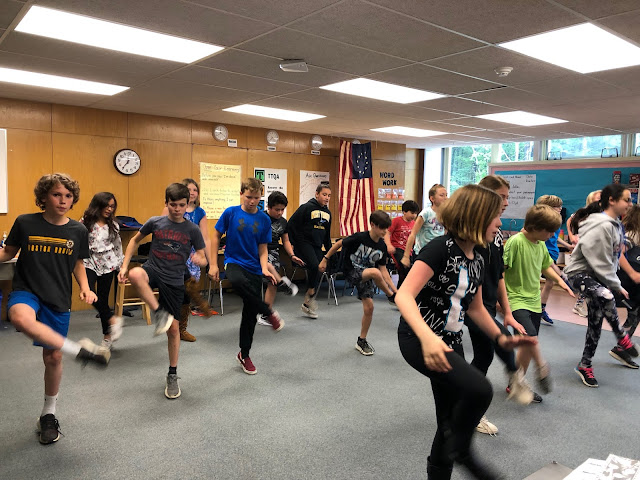
It looks like westward expansion is about to spark a divide across the new nation, as settlers moving into the western frontier debate the ...