Friday, June 1, 2018

Understanding Content Through Experiential Learning

We're full speed ahead and on to our final interdisciplinary novel study of the year: Iqbal by Francesco D'Adamo. This novel (based on a true story) tells about the life of a young Pakistani boy named Iqbal Masih, who was sold into debt slavery at age four, was rescued by social activists at age 10, and quickly became a global symbol and outspoken public advocate against child slavery, only to be assassinated at age 12. While tragic, this story implores us to take a deeper look into the relationship between governance and poverty. 

We began the novel unit by building some basic background knowledge on child labor practices experienced across the world.  Students quickly connected these introductory lessons with our prior study and analysis of responsible sourcing and consumption related to cobalt mining in the DRC (love to see those global connections!). As we seek to connect our learning with the Global Goals, this novel unit aims to help students explore and better understand unfamiliar cultural and social patterns in the world, how poverty can take shape in ways we never could imagine (particularly, human rights violations), and the stories of hope shared by those enduring extreme hardships and suffering as well as the impact of advocacy.

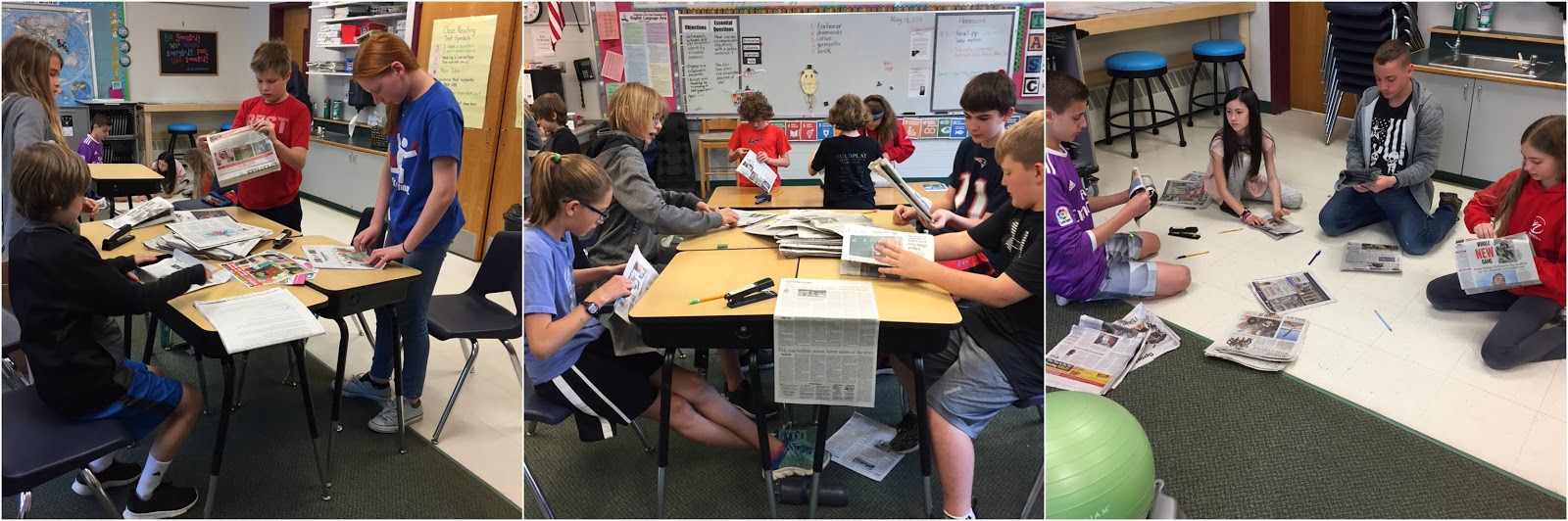
One of the lessons students recently engaged in involved experiential learning, where students were immersed in a hands-on learning experience that promoted reflection and the evolution of new attitudes or ways of thinking about the world we live in.  This particular experience had students participate in a sweatshop simulation. Students explored sweatshop conditions and child labor practices as they made paper bags for low wages and under repressive conditions (relatively speaking, of course). So, what's it like working as a bonded laborer for a demanding and unsympathetic master who forces you to work hard and fast with little room for error and under constant threats in less than ideal conditions? How did this experience change their attitudes about this issue? What comes next? Whose job is it to establish and enforce laws that are supposed to eradicate forced and/or bonded labor?  Student reflections included:

"How do these children make enough money to support their families?  Do they even really make any money at all because it seems like the shop masters are constantly threatening to reduce or take away their wages"?

"My group didn't even make enough money to buy basic necessities like food and medicine, and we made a lot of paper bags!"

"Laborers are powerless compared to their shop masters. They are at the mercy of whoever they work for and probably will be for the rest of their lives unless someone more powerful than them puts a stop to this."

"I'm going to start paying attention to where the products I use come from.  Maybe I could do a better job sourcing products more responsibly.  If everyone did that, maybe there would be less demand for products made in sweatshops, which means less child labor."

"I learned that working together as a team made a big difference in our productivity. Each of us used our strengths to contribute to the paper bag-making process and we were able to produce more bags once we finally figured out how to work together."

"We would have had to work for 14 hours to make enough money to purchase enough food for just one person for one day. How do these people support their entire family? When would they ever be able to break the cycle of poverty?"

"Bonded labor should be illegal. These powerful shop masters have too much control and are not treating children fairly. Aren't there laws that are supposed to prevent this from happening?"  

"This is a bad situation and Iqbal Masih is no longer alive to help publicize what is really going on and advocate for slave children. What does the International Labour Organization do to help these children? Who enforces laws to protect children when governments aren't doing their job?"

One of the best parts of this learning experience was witnessing the independent research initiative that took place after the simulation ended. Students expressed a keen interest in learning more about government reform, international child labor laws and the enforcement of those laws, particularly related to carpet weaving factories in Southeast Asia. Little did they know, they were planting their own seeds. 


Monday, May 21, 2018

Middle East Peace Summit Simulations

As you may recall from my earlier blog communication, students had been preparing for and were participating in a Middle East Peace Summit simulation during their social studies classes. This simulation was based on a United Nations-led effort to bring together many elements of both Israeli and Palestinian societies to hold discussions about the needs and interests of both sides before entering into formal negotiations. The simulation provided an opportunity to view this longstanding conflict from the perspectives of those immediately impacted by it: in particular, the communities of ordinary Israelis and Palestinians who have yet to see much benefit in their own lives from the peace process. Students had the opportunity to role-play ordinary Israelis and Palestinians engaged in discussions about the conflict, the peace process, and the potential impact of real peace in their daily lives as they presented their formal proposals for lasting peace in the region.

This process proved to be an engaging and enriching experience for students as they gained a deeper understanding of the underlying reasons for the conflict and listened to the needs and interests of parties on the other side of the divide. Though an agreement for peace was not achieved at any of the three summits, students gained firsthand experience of the challenges confronting those who tackle the issue of peace between the Israelis and the Palestinians and how these parties might better forge a path to peace going forward.

Special thanks to Mrs. Kosakowski, our digital literacy specialist, for preparing the maker space for our peace summits and for creating a digital recording of each of the three summits as a witness to history. Please click on the links below if you are interested in viewing these peace summits.

Note: Many of the resources, materials and language used for this simulation and blog communication were obtained from the United States Institute of Peace and its Simulation on the Israeli-Palestinian Conflict documents. 


Mrs. Valzania's homeroom class (above)


Mrs. Sierpina's homeroom class (above)


Ms. Magee's homeroom class (above)

Thursday, May 17, 2018

Worldly Weather Broadcasters

Students are currently studying the climate of South Asia and learning how seasonal weather patterns affect this particular region.  With half of the climate zones that exist on Earth located in South Asia, people living in that region must adapt to widely varying conditions. There are so many different human interest stories related to the monsoon seasons in this part of the world - stories that demonstrate the significant impact these seasonal winds have on the environment and lives of the people living there. It seemed fitting to have students demonstrate their knowledge and understanding of the climate in this region by creating a learning product that would showcase not only their understanding of the climate, but how the climate affects how and where people live in South Asia - the essence of geography!  

Pairs of students were assigned to a season (summer monsoon or winter monsoon season) and conducted an in-depth investigation relating to the temperatures, precipitation, monsoon wind direction and the resulting impact on the people and environment - flooding, droughts, the spread of disease, landslides, water scarcity, etc. Students used their research findings to create a weather broadcast using Flipgrid, complete with some very creative and relevant human interest stories.  

Tune in to your "local weather station" by clicking on the image below and check out our South Asia weather broadcasts. I definitely see the potential for some future careers in broadcasting. 😀

Featured Article

And We Danced

It looks like westward expansion is about to spark a divide across the new nation, as settlers moving into the western frontier debate the ...