Wednesday, May 29, 2019

And We Danced

It looks like westward expansion is about to spark a divide across the new nation, as settlers moving into the western frontier debate the issue of slavery in the new states beyond those acquired under the Louisiana Purchase.
As the southern economy grows increasingly dependent on cotton and preserving the institution of slavery to sustain it (as well as states' rights), Northerners are outwardly declaring their opposition to slavery and the need to abolish it. This tension eventually sparks a Civil War in 1861, creating a secession from the union of seven southern states. This three-year war would ultimately become a defining time in our nation's history, determining what kind of nation it would be. The difficult process of rebuilding a united indivisible nation, free of slavery, would soon begin. 
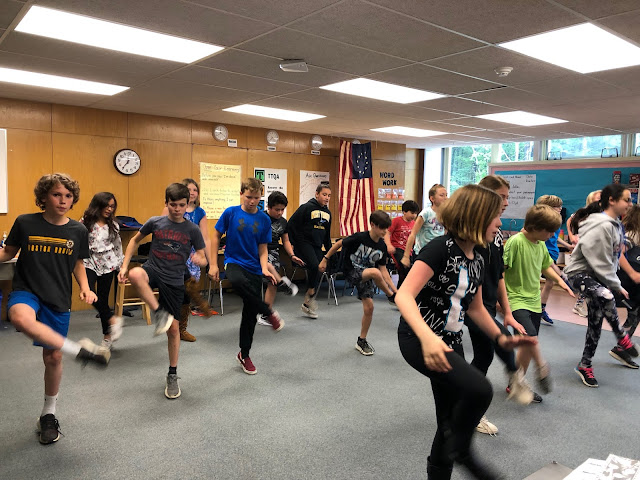
As part of our two-week Journey Through the Civil War simulation, learners were introduced to the music of this era - songs like Dixie's Land, John Brown's Body, and Tenting Tonight - and connected with the emotions and mood these songs might have evoked among Americans and the importance of music during this time of conflict. When soldiers from both sides marched off to war, they took their music with them to help pass the time; to entertain and comfort; to keep the memories of home and family alive; and to help create and strengthen bonds between comrades. More than entertainment, music provided a valuable way for Americans and enslaved Africans to express their thoughts, feelings and hope about this pivotal conflict. What students were surprised to learn, was that many of the songs and dances of the Civil War era (and pre-Civil War era) inspired the American Folk Music movement, which ultimately inspired some of the music and dances our groovin' 5th graders enjoy today. Square dancing, a modified version of nineteenth-century ballroom dancing, was the inspiration for modern line dancing - dances such as Cotton-Eye Joe, Macarena, and the Cha Cha Slide. We learned the origins of some of these songs (and accompanying dance steps) and how early European settlers brought their culture with them to the new world, forever influencing the music and dance we enjoy today. If it hadn't been for Cotton-Eye Joe, you'd never get a chance to see learners doing this:


Friday, May 10, 2019

Poetry Palooza!

Spring fever is certainly settling in. What better way to keep the kids' engaged (and practicing their writing skills) than to have a Poetry Palooza!

Poetry creation rotation stations allowed the kids to move around, to share ideas, and to be their best creative-thinking, problem-solving selves all week long.  These learner-centered activities allowed students to apply their knowledge and understanding of literary devices and structural elements of poetry, while having the freedom to wholeheartedly create and enjoy the writing process. Students created a variety of poetry, including blackout poetry, book spine poetry, paint card poetry, flip side poetry, roll-the-dice poetry, newspaper poetry, found poetry, and haiku.  A culmination of the week's activities will result in 'Open Mic Monday', where, students will present their poems orally to the class next week. 


Friday, April 26, 2019

Perspectives on Westward Expansion


SOLD! Thomas Jefferson just pulled off the real estate deal of the century, purchasing the entire Louisiana territory for a song while nearly doubling the size of the United States in the blink of an eye. America would acquire 830,000 square miles of land containing forests, farmland and an abundance of valuable resources for $15M (equivalent to approximately 3 cents per acre). In addition, America would now have vital access to the Gulf of Mexico, offering open and free commerce for goods traveling via the Mississippi River. Look out, world. America is about to become a continental power.
While the deal would be considered one of Jefferson's most notable achievements as President, it would have equally powerful, yet much less desirable cultural and social consequences for others - particularly, Native Americans, not to mention the Spanish, French and enslaved Africans who had also been living in that same territory at the time of the acquisition. In what ways did the deal affect EVERYONE involved?
Learners began researching and analyzing the impact this deal would have on varying groups of people - from its strongest supporters to its fiercest opposition. They then viewed this issue from the perspective of either a European American (federalist or democratic-republican), Native American, Spanish settler, French settler or enslaved African living in the territory in April of 1803 (just months before the Louisiana Purchase Treaty was ratified). What reasons would they have to support or oppose the deal? How would they show their support for the ratification of the treaty or will they try to convince France to withdraw their offer to sell the territory? Learners are in the process of creating public service announcement campaigns (PSAs) to inform the public about the issue from their perspective, offer a possible solution and request a call to action. The PSAs are being created in a variety of media formats (flyers, pamphlets, videos, etc.), as they learn about the powerful impact PSAs can have on influencing people's ideas and beliefs about important issues happening in the world around them. Couple that with social media and you're looking at future influencers capable of reaching all pockets of the globe and (ideally) becoming ambassadors for good. Stay tuned for more on this. We're using the skills and competencies we develop from this project as a springboard for a future PBL that connects our previous Atlantic Slave Trade unit with our upcoming Civil Rights unit. 


Wednesday, April 10, 2019

Empowered Thinkers


Learners have spent the last couple of weeks taking a deep dive into the one-term presidency of John Adams, the tumultuous presidential election of 1800 and the personal and political life of Thomas Jefferson and his attempts to unite a nation. Did these two presidents follow the advice of George Washington? What impact did these men have on the new republic in those formative years and the years to follow?

We can learn a lot about the beliefs and values of other people by listening to the words they say and paying close attention to their actions. What can be said about someone who acts in a way that is inconsistent with, or even the opposite of, their stated beliefs?  Learners examined a variety of primary source documents containing statements made by Founding Father and third U.S. President, Thomas Jefferson, and investigated his actions to determine if he lived up to his word. Careful consideration was taken not to lead their thinking or offer any preconceived notions (my job is to teach children how to think, not what to think). This exercise was simply meant to offer students an opportunity to further develop their critical thinking skills and offer them opportunities to analyze and evaluate information so that they are able to make their own informed judgments about their research - one of the most important literacy skills we can develop in learners. The conversations during the Gallery Walk were certainly worth listening to. In hindsight, I should have recorded some of their exchanges. They were that good. They were most thoughtful in their evaluations and were careful to hone in on the evidence that would support their conclusions. Their discussions were less about opinion and more about facts - they were modeling for one another the type of thinking that happens when one feels empowered to choose their own thoughts about the information they are receiving. While students came to different conclusions about Jefferson's beliefs and values, each had solid evidence to support their thinking.

The BIG questions: What do we do with this information? How does this help us as learners? 

Learner Reflection: 
  • I feel like I can decide for myself about how I think about information. I don't have to let someone else tell me how to think about what I read.
  • This was challenging, but not frustrating. I was able to make sense of all of the information and decide for myself what it meant.
  • This was kind of hard, but I did learn two new things: 1) that Thomas Jefferson's actions didn't always match up with his words and 2) that I can look at information and decide for myself what it all means.
  • I feel smarter now that I can look at information and decide what it means. I'm a good bias detective and know that someone else's opinions and beliefs don't have to be my own opinions and beliefs.
This is what twenty-first-century literacy looks like. 

Friday, March 29, 2019

Six-Star Socratic Seminars


Our savvy historians spent the week exploring a collection of primary source documents related to Washington's private and public life, with the goal of not only thinking through these documents for contextual understanding but to also analyze and extract information to make informed conclusions and judgments.

Through a series of primary source artifact stations (newspaper articles, letters, will and testament), students were able to investigate the motives behind the artifacts, giving students a sense of place, chronology and empathy with regard to the decisions that were made during a time when important precedents were being set for our nation - precedents that paved the way for the stability, equality and fairness that would develop under the new democratic republic. Learners were notably intrigued by Washington's evolving views on slavery, starting with his inheritance of enslaved people at age eleven and eventually promising their freedom upon his death. During their investigation, it was clear that they were gaining a true understanding of the weight of responsibility Washington felt in shaping the new nation and his desire to leave behind a legacy that exemplified character, humility and unwavering love and hope for our country. 

Students also explored Washington's farewell address, analyzing specific excerpts to help better understand the advice that Washington was offering to help move the nation forward. Their in-depth analysis was used to help them prepare for their first official Socratic seminar. Through these seminars, students shared and explored thoughts and ideas that extended their thinking beyond the document, bringing relevance and meaning to our lives today. I was both surprised and fascinated by the insightful connections that learners were making during their discussions, particularly the connections they were making between our nation's past, present and future. Washington would have been in awe.

Thursday, March 21, 2019

Fabulous Figurative Language Fun

Alliteration, hyperboles, similes, metaphors, idioms, personification, onomatopoeia, proverbs, adages - the fun is neverending!

Over the last couple of weeks, learners have been developing and applying their understanding of a selection of figurative language techniques through a variety of interactive learning experiences, such as:
  • Mr. Bleeker's alliteration ice cream flavors
  • Hyperbole rap music
  • Making "Idiom-ade and Hyperbole-tea"
  • Onomatopoeia Pictionary
  • Simile/Metaphor Flip Flop
  • Personification Spot It and Steal It
  • Fortune Cookie Proverbs
  • Proverbs & Adages SCOOT

These activities were not only a fun way for students to develop and apply their understanding of several different types of figurative language, but more importantly, WHY figurative language is used and how it can make stories, poems, brands, headlines and advertisements more appealing to readers or consumers, enabling them to construct deeper meaning from their reading or create a more memorable consumer experience. We'll continue to apply our knowledge and understanding of these types of figurative language techniques during our upcoming Poetry Palooza! 

Shown below are some of our learners playing Onomatopoeia Pictionary. This game was a huge hit (lots of moans and groans when it was time to transition out of it - always a good sign).


Thursday, March 14, 2019

The Problem With Representation

Sign a treaty that establishes independence from Great Britain. Check. 

Americans are now free to form their new nation. What comes next?  Creating a government that protects the freedoms and liberties of its people, of course. I mean, after all those years of living under the tyranny of King George III, what else could be more important?  

Questions for learners:

  • What actions are necessary in order to start a new government?
  • What would be the role of the leaders of the new nation?
  • What would one of the major concerns be in preserving the new government and nation?
Lest we forget, Americans had just fought the British and King George III for many years. They were scared to give power to any one person. They definitely didn’t want another king and they certainly didn’t want a strong, new leader who might tax them heavily like the last one.

Let's see... Let's not elect a president, let's give all of the power to each individual state and very little power to the national government. That should do the trick. With that, the Articles of Confederation were drafted and ratified. The state of being free from the control or power of another was surely a welcome change for American citizens. That is, until the smaller states, like Delaware, Rhode Island and Georgia, realized that the system of representation was flawed.

To effectively demonstrate the early problems with strict proportional representation, our learners took part in a simulation titled "Last Tower Standing". Learners were assigned to groups comprised of 8, 6, 4, 2 or 1 persons, depending on the size of the population in the state that they were representing. For example, Virginia was the group of 8 learners representing the most populous state at the time, and Delaware was the solitary student, representing the least populous state. Each person received 3 wooden blocks and $20 (like dollars, only because I did not have the different types of currency each state was producing). Each of the groups were tasked with building the largest and most stable tower using the blocks provided and that they had to work together with members of their state to achieve this (I'm sure you can see where this is going). Most saw this as a competition. Delaware was obviously the first to finish while Virginia was carrying out an elaborate design plan, desperate to win the challenge given their abundance of blocks. It didn't take long for Delaware and Georgia to declare the challenge unfair (phew - things were off to a good start). Students were then asked to propose solutions to the problems that some of the states were facing, but any and all proposals had to receive a 4/5 majority vote in order to pass. Delaware and Georgia proposed several solutions, all of which garnered very little, if any, support. Why would Virginia or Massachusetts want to sacrifice their resources in order to let another state win the challenge? Virginia even wanted more access to blocks and asked if they could purchase more blocks with their funds to ensure their win. How could these problems be solved? It was a lengthy discussion, but learners eventually realized that they weren't exactly behaving like the "UNITED" states they had so confidently called themselves. There were obvious problems with the current government structure. It was broken and it needed to be fixed. Oh, and throw all of those angry farmers who felt they were being treated unfairly into the equation (Shays' Rebellion) and you have a recipe for a British takeover. There was no way Americans were going to let THAT happen. Not after everything they had been through. So, what could happen if Americans actually stood together? It's what's coming up next as we march to Pennsylvania's Constitutional Convention to rewrite our nation's frame of government; where we will form a nation through compromise. 
Left: Virginia (5C), Middle: New Jersey (5C), Right: Delaware (5V)
Left: Delaware (5B), Middle: Massachusetts (5B), Right: Georgia (5B)

Friday, March 1, 2019

The World Turned Upside Down


Who would have figured that a young, scrappy and hungry ('Hamilton' - I couldn't resist) army could defeat the most well-trained and disciplined army in the world? With the help of their French allies, General Washington's army achieves a victory in Yorktown; a pivotal moment in the Revolution... BRITAIN SURRENDERS! Independence from Great Britain is now closer than ever. As patriots (aka students) worked toward negotiating a peace agreement with Great Britain, there was certainly cause for celebration. What better way to rejoice than holding a tea party, of course! These soon-to-be Americans celebrated jubilantly, sipping tea as one does (notice the pinkies), and discussed their terms for the peace treaty. See you in Paris in 1783 with quills in hand!


Wednesday, February 27, 2019

Rally For the Cause


“The harder the conflict, the greater the triumph.” - General George Washington


We're knee-deep in the trenches here, folks. [Before the February break,] a British victory at The Battle of Long Island sent colonial troops retreating to Trenton. Those cold, winter months that followed, did a number on the morale of General Washington’s army. Soldiers were tired, cold, hungry, terrified, longing for their families, and at the end of their enlistment period. General Washington desperately needed our help. The battle for independence must continue! Colonists (aka students) promptly decided to rally for the cause. Shown here are some examples of their rally cries. And they worked! The troops have rallied. The battle continues! (Oh, and yes. You'll notice a British General's cry for continued action on their part, too. He just couldn't help himself. Those rascal redcoats).


Thursday, February 7, 2019

To Declare or Not Declare?


Colonists (students) have been discussing their next move in the Revolution. In light of the events leading to date, including unfair taxation and trials, the king dissolving colonial legislatures, and a host of other grievances (not to mention the fact that Great Britain is now waging a war against the colonies), they feel that it is probably best for them to consider a course of action that would dissolve the relationship between the colonies and Great Britain. Certainly, these colonists have a whole lot to lose if their attempts to win the revolution fail, but they've come to the conclusion that this may be their only viable option.

Enter the Declaration of Independence. 

We spent some time breaking down the document into four main parts: the preamble, natural rights, grievances, and the resolution; then analyzing each of the parts with the goal of making the structure and content of this important document easier to understand (generally speaking). I'd like to note that the hypocrisy in the "all men are created equal" statement did not go unnoticed by students. It led to an important conversation about equality (particularly with respects to enslaved people, women and Native Americans) and the mindset of many during this period in history. We discussed how far we've come since this time and acknowledged how much more progress still needs to be made. Our country, much like us as individuals, is certainly a work-in-progress. I was also pleased to see that students were able to identify many of the colonists' grievances before we even reviewed that particular section of the document. Yes, yes! They truly seem to understand how we arrived at this moment in history!

Following our analysis of the Declaration of Independence, colonists participated in a simulation involving a shared discussion activity where they each took on the role of one of the individuals who signed the Declaration and the process under which they contemplated the extremely difficult decision to break ties with Great Britain. To better help students understand the seriousness of this decision, they were asked to consider and discuss the following questions with their fellow members of Congress:


What dangers do we face ourselves if we declare independence from Great Britain?

What are the positive things that could happen if we declare our independence from Great Britain?

What could we do to make a compromise with Great Britain? Do you think it would work? 


What are some grievances or complaints we have against Great Britain? 


Can our army handle a war against Great Britain?

What sacrifices will regular citizens have to make if we go to war with Great Britain?

How will Great Britain treat us if we declare our independence and then lose the war?

And the very last question to be discussed: Who votes for independence? Will you risk your life to sign this document? 

Most students came to the conclusion that signing the document was the best course of action. Interestingly though, there were actually two loyalist-minded students who thought that surrendering to Great Britain would most certainly produce a better outcome than continuing the war. That, of course, prompted further inquiry as to what would have happened to them as a result and how our own lives might be different today had that actually happened.

Looks like the signed Declaration is being delivered to the king. How will he react? What will happen next? One British soldier (shown below) is convinced that British troops will undoubtedly conquer. Despite the fact that he is constantly surrounded by angry patriots who are motivated to win, he refuses to withdraw his troops. This soldier is determined to stick it out until the bitter end. And it will be bitter indeed.
Above: Patriots (actually, Patriots fans) taunt a British soldier.

Below: Delegates from the Second Continental Congress discuss the risks and rewards associated with signing the Declaration of Independence.


Friday, January 25, 2019

Tea + Salt Water = Fire + Gasoline


Here we go... That little stunt the colonists pulled at Griffin's Wharf in the Boston Harbor.... You know, the one where they thought it would be a brilliant act of defiance against British rule to dress up as American Indians, board British merchant ships holding 90,000 pounds of tea and dump all of it into the harbor. What were the colonists thinking and how would His Majesty react to such a scandalous act? "Take that, King George III!" a member of the Sons of Liberty was overheard saying. 

Hold your horses. Not so fast.

"Colonists" (aka students) arrived today delighted that it was "pay day" in the colonies. They eagerly waited for the payroll manager to visit them with the beloved "till" - hands out, ready to add a fresh sum of money to their stash and tally up their new fortune. You can imagine how quickly the mood changed when they learned that His Majesty, in response to the colonists little late night "escapade", declared several new acts; these Intolerable Acts were much more punitive in nature. It sure took the wind out of these scallywags' sails. In addition to a host of new laws that would hamper economic growth in the colony of Massachusetts, prohibit town meetings or the creation of government charters within the colonies, Parliament insisted that all colonists must hand over all of their money to the King to make up for the loss of income from the tea (this last part for purposes of our simulation to demonstrate the harshness of The Intolerable Acts). Let's just say it got loud. Real loud. Close to what some might even call [shhhh..whisper] anarchy. Such a harsh punishment might prove to be the end for the colonists. How would they support their families? How would they be able to keep their businesses open? How would the colony survive? Colonists firmly decided that something had to be done and they were pretty darn tired of letting the King decide their fate. In yet another act of defiance, colonists formed the First Continental Congress and held their meeting today to vote on opposing and rejecting these most recent laws, refusing to engage in any further trade with Great Britain, and establishing a Grand Council that would allow colonists to create their own laws, tax its own citizens and raise an army. Pardon me? Did the colonists just say "raise an army"? I think I smell a revolutionary war brewing...

Speaking of The Boston Tea Party... we spent some time this week analyzing political cartoons depicting this event and the presence of bias and how it can influence our beliefs and understanding of history. Students were very quick to detect the presence of bias in each of the images below. We discussed why one artist might depict the event as a heroic act of defiance, while another artist might show it as an unruly, criminal act? How does bias influence our own thinking? It was the perfect introduction to learning more about how to identify bias and think critically about information, always seeking to understand both sides of an issue and the quest for fact-based information to make informed decisions about not just history, but the world we live in today. This may be one of our most important explorations as fifth graders yet. 


(Above): See if you can identify the bias in each of these artistic interpretations of The Boston Tea Party.
(Above): Talk about angry protests...
(Above): Patriots deliver their strongest arguments in support of the congressional proposals. 

  1. (Above): Colonists meet with their political groups and strategize for the congress. 
(Above): Chairpersons from two of the congressional meetings attempt to maintain order throughout the event.

Tuesday, January 22, 2019

Hear Ye! Hear Ye!


Hear Ye of Boston! The events in the "colonies" as of late... 

His Majesty has declared that in order to raise revenue for the empire, the following acts are necessary: Colonists must pay taxes on glass, tea, paper and paint purchased from Great Britain.  More spies, coast guard vessels, and officers will be employed to prevent smuggling.  Writs of assistance will be issued allowing these officials to search anyone at anytime without reason. These rebellious colonists were found in violation of this act (possessing paper purchased from Great Britain, of all things!). Tsk.Tsk. When will these foolish Patriots ever learn that His Majesty always knows what's best for them. 


Thursday, January 17, 2019

It's Getting Rowdy In Here!

Tension certainly seems to be rising across the colonies as many British colonists express their anger over parliament's unfair laws that are being inflicted on them. They've begun to organize secretive groups aimed at undermining British rule in their colonies. They call themselves The Sons and Daughters of Liberty (aka Patriots).

Delegates (students) from nine of the thirteen colonies gathered in New York (Room 26) this week for a meeting of The Stamp Act Congress to express their opinion that all British subjects should have the right to vote on taxes through representatives. Delegates representing both the Patriots and Loyalist parties, as well as Neutralists, gathered to decide the fate of the Stamp Act and to seek acknowledgment of British citizens' [colonists] right to a trial by jury. Patriots and Loyalists spent some time preparing for the meeting by gathering evidence and strategizing with their respective parties on how to persuade the Neutralists to side with them, with the hope of garnering enough votes to persuade King George III and his parliament to repeal these new laws. It was quite a lively debate - the chairpersons surely had their work cut out for them as they tried to maintain peace and order during these meetings. At the conclusion of this session, a majority of the votes favored most of the Patriots' proposals. Looks like they're gaining momentum. As you can imagine, Patriots are now demanding to find out what will happen next.

Yikes. It sure is getting rowdy in here!


Left: Loyalists cheer as proposal #3 (We will not import or purchase British goods) receives a majority of 'nea' votes. Middle: Chairperson, "Mr. Cyrus Wiggins", attempts to keep the peace during the congressional meeting. Right: Delegates from the patriot party attempt to persuade neutralists to vote in favor of proposal #5 (The Stamp Act must be repealed by parliament).

Friday, January 11, 2019

The Road to the Revolution

It's been an eventful week in Room 26. War drama played out on stage, there was a war simulation, and we even received a visit from Her Majesty The Queen!

All had been relatively calm in "the colonies" until this week. We began the week learning about the causes and effects of the French and Indian War. Our understanding of this all-important event in our nation's history was played out on "stage" as students from each of my social studies classes performed a reader's theater script to gain a deeper understanding of the cause and effects and key people involved in the war. Later in the week, students enjoyed a game-based learning experience where they participated in a French and Indian War simulation, digging even deeper into why various groups of people were moving into the Ohio Valley and how and why it sparked a conflict. We ended the week with a visit from "The Queen" (acting on behalf of her husband, King George III). The Queen arrived with members of parliament and her tax collectors to assess taxes on the British colonists to help pay for the war debt and to further secure British territory. The colonists were none too pleased indeed. Bitter outrage ensued as taxes were assessed for various incidents and circumstances and money (aka Smarties candies) was slowly siphoned from the colonists. Are they beginning to get a sense of what taxation without representation means and how both Britain and the colonists felt about it? You bet and it's only the beginning...
Students perform a reader's theater script of the French and Indian War.  See if you can identify Colonel Washington.  :)

Fun with game-based learning: a French and Indian War simulation to help demonstrate how conflict arises and what it looks like as tension increases. These kids (playing the roles of Native American, French fur traders and British settlers) are all in!


Some of the British colonists publicly demonstrate their displeasure over taxation without representation. Booooo!


Friday, January 4, 2019

Book Clubs: Beyond the Book


This week, students participated in their third round of book club meetings (aka literature circles) related to our dystopian novel unit. Why a dystopian novel unit and what's all the hype?

Essentially, dystopian novels explore what life could be like if citizens don't pay attention to today's problems (environment, government, social issues, etc.). They offer a range of opportunities that promote the development of critical thinking skills and deep discussion. "Dystopian novels are known to be characterized by an imaginary future world or society, tightly controlled inhabitants, conformity as good and individuality as bad, and a main character who is frustrated by the controls and acts in spite of them." - James Patterson.

Hmmm… Perhaps this genre resonates with kids because, to some extent, they are beginning to experience some of the same challenges as the novels’ characters (relatively speaking, of course) - their struggles against unfair "authoritarian regimes” with little control over their own lives.

As a teacher, I love dystopian novels for their prevailing themes of HOPE and DETERMINATION. This genre inspires students to consider their own world beyond the book (the pinnacle of comprehension!). Maybe it's the idea that our world or society can change and that anyone, including young people (yes, even 5th graders), have the power to change it. What's more, is that these novels promote the development of empathy and analytical thinking skills - sure signs of maturing minds.
Top 3 Reasons Why Students 💜 book clubs:
1.They’re fun.
It’s a social learning experience. Students help each other understand a text and make sense of it. They use each other as resources and become independent learners. Students are expected to talk A LOT; to debate and argue their ideas. Students are encouraged to bring their experiences and feelings to the meetings and to share them.
2. They involve choice.  
Through the experience of a "book tasting", students are given the opportunity to evaluate a selection of books (in this case, a selection of six dystopian novels), rank the books according to their interests and from there, book club groups are formed. Choice leads to deeper engagement, increased intrinsic motivation, and an opportunity for guided decision-making.
3. Connections are made.  
When the classroom learning experience is positive, students feel more connected to school and are motivated to learn. This can lead to more positive academic interactions with classmates and teachers and overall increased academic success.
Aguilar, Elena. “The Power of Literature Circles in the Classroom.” Edutopia, 30 Nov. 2010
"Dystopian Genre: Why Kids Love Reading About The Bad Place." WeAreTeachers, 27 June 2017, www.weareteachers.com/the-bad-place-why-kids-love-dystopias-2/.

Tuesday, December 18, 2018

Colonial Chatterbox: Podcasting "History"


Our first official podcast of the year is now available for your listening and learning pleasure!  As you all know, students in each of my social studies classes have just completed a unit on the early colonization of North America through a project-based learning experience.  Students researched and analyzed geographical information prior to designing and creating their version of the ideal colony and then designed marketing campaigns to "sell" it to prospective settlers.  During the colonization process, students worked with the amazing Mrs. Kosakowski (our digital literacy specialist) to create a series of podcasts that would highlight important phases of the project from the perspective of "colonists".  We hope you'll take a few moments sit back and enjoy listening to these podcasts, as students show you all that they have learned about early colonization in North America and how geography influences the development of communities.  Below is the first of five "Colonial Chatterbox" podcast episodes.  To listen to the remaining four episodes, I've posted a link to the entire podcast series just below episode one.  Enjoy!

Colonial Chatterbox: Episode One (This Colonial Life):


Colonial Chatterbox (all five podcast episodes) - click here: Colonial Chatterbox podcast

Friday, December 14, 2018

In the Spirit of Giving

Our class participated in a local community service project this week, supporting an initiative led by the Community Giving Tree here in Boxford.  The Community Giving Tree's mission is to help low-income families in northeastern MA raise healthy children by providing recycled clothing, baby equipment, and other basic necessities. Every year, CGT distributes these much-needed items to more than 10,000 children. One of the items they look for, particularly during the cold weather season, are new blankets.  Students decided to earn a few dollars by doing extra chores around the house and in their neighborhoods.  They then donated their earnings toward the purchase of materials needed to make no-sew fleece blankets.

Realizing that we needed lots of room for this project (given the size of each of the blankets), we gathered in the gymnasium to make the blankets.  Students worked in pairs to make a total of ten double-sided, fleece blankets. It was great fun to see how much enjoyment the children were getting out of making them, knowing the blankets would eventually make their way into grateful hands.

Small hands, big hearts. #wearemakingadifference


Wednesday, December 12, 2018

Just Listed!

As promised, here's a VIP look at each of the three colonies established by students in Mrs. Bouffard's, Mrs. Cummings' and my homeroom classes. I've also included a few of the digital marketing campaigns (TV commercials) that students created, advertising the Doppeland and New Timboria colonies (they're at the very end of this post). Be sure to stay tuned for a final update on our podcasting segment of this project!

  Welcome to NEW TIMBORIA! (My homeroom class):


New Timboria: colonial village, colonial home, blacksmith, schoolhouse
New Timboria: farm, quilt maker, weaver, colonial home
New Timboria: shipbuilder, potter, colonial home, tanner

  Welcome to GREENVILLE! (Mrs. Bouffard's homeroom): 
Greenville: colony, colonial home, military outpost, boathouse
Greenville: schoolhouse, colonial home, blacksmith, military outpost
Greenville: colonial home, doctor, weaver, town hall/meetinghouse


  Welcome to DOPPELAND! (Mrs. Cummings' homeroom):


Doppeland: colony and three different colonial homes
Doppeland: potter, shipbuilder, schoolhouse, farm
Doppeland: doctor, shoemaker, weaver, blacksmith

Have a look at these marketing campaigns (TV commercials) created by some of our tech-savvy students:


Featured Article

And We Danced

It looks like westward expansion is about to spark a divide across the new nation, as settlers moving into the western frontier debate the ...